
Metallica is arguably the most beloved metal band in music history. Heck, they are one of the most popular bands period. They’ve sold millions of records since their thrashin’ journey began in 1983 with “Kill em’ All.” So, it makes sense that Epic Games would choose them to be showcased in the latest season of Fortnite Festival.
I never imagined Lars, James, Kirk, and Rob would be jumping out of a battle bus and hitting the griddy, but here we are! They also performed on June 22 and 23 in a Metallica themed event called Metallica: Fuel. Fire. Fury that showcased six fan favorite songs.
Metallica is just one of the latest bands to join the illustrious group of artists who have made appearances in “Fortnite.” However, unlike Lady Gaga, Ariana Grande, and Travis Scott, Metallica is a traditional rock band. From what I can tell, “Fortnite” has not featured a full band in this capacity (let me know if I’m wrong in the comments). This opens the door for other rock bands to perform at the biggest festival in gaming.
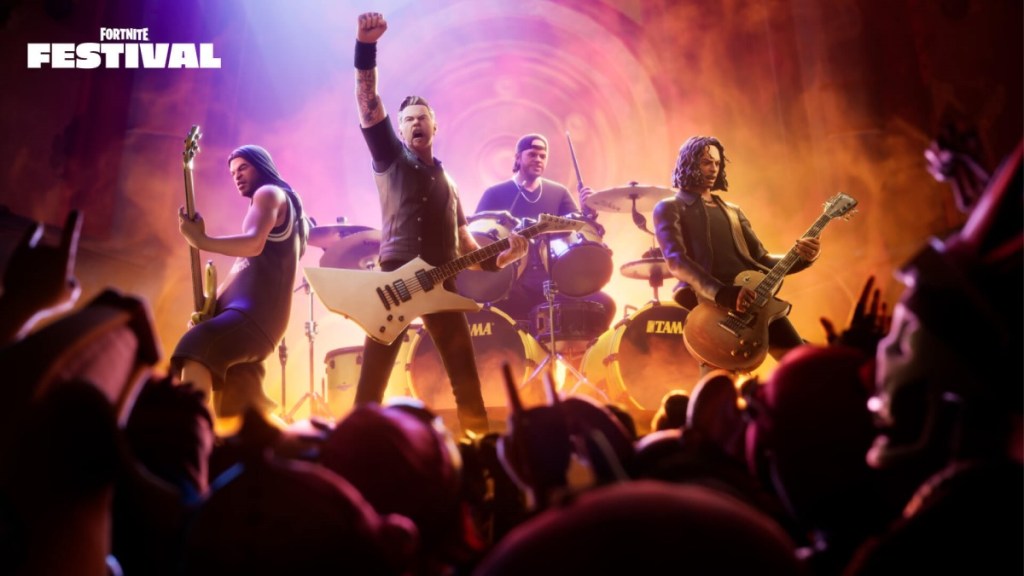
This got me thinking, now that we can get some full-fledged rock bands in “Fortnite,” who would make great additions to the Fortnite Festival? After mulling it over for some time now, I think I have the perfect choice: Rush.
One of a few bands to popularize progressive rock, the Canadian trio Rush had been around for over 40 years up until the unfortunate passing of drummer Neil Peart. They have influenced a plethora of bands spanning different genres including Dream Theater, Rage Against the Machine, The Smashing Pumpkins, Beck, Porcupine Tree, Foo Fighters, and Metallica just to name a few. Peart alone has probably influenced thousands of drummers, including myself.
Not just that, but The Holy Triumvirate have an incredibly diverse catalog that spans across a whopping 19 studio albums that would make for a fun musical journey. Imagine flying with Dirk, Lerxst, and Pratt on a spaceship called the Rocinante (a nod to the songs “Cygnus X-1” and “Cygnus X-1 Book 2: Hemispheres”) as you travel through the group’s various eras. Here are seven songs I think would be perfect for this time machine tour:
- Finding My Way
- 2112 (I. Overture and II. The Temples of Syrinx)
- The Spirit of Radio
- Tom Sawyer
- Subdivisions
- Roll the Bones
- The Garden
This setlist tells a story of the band’s history. Beginning with “Finding My Way,” the first track on the self-titled album released in 1974. Although it features John Rutsey on drums rather than Neil, I think showcasing that is imperative to telling the band’s story through this visual experience. It may not be the song that got the most radio play – that would be “Working Man” – but it is the one that started it all.
There were two albums released after the self-titled album. Both released in 1975, “Fly By Night” introduced Peart to the band and included the fan-favorite tracks “Fly By Night,” “By-Tor and the Snow Dog,” and “Beneath, Between, and Behind”; “Caress of Steel” has a mix of deep cuts and fan-favorites like “Lakeside Park,” “The Fountain of Lamneth,” and “Bastille Day.” However, the latter has been noted as the album that almost killed the band. Looking back, it’s a fantastic album, but it was not well-received critically at the time of release. Luckily, their next album is one of the most influential prog albums of all time.
Released in 1976, “2112” is arguably Rush’s most important album. Not only did it cement the band’s place as one of the greatest prog rock bands, it legitimately saved the band from being cut from their label. Due to the underwhelming reception of “Caress of Steel,” Rush was given one more chance to prove to Mercury they can make a hit. While there was pressure to make something more commercially successful, Rush did the complete opposite. They stuck to what they wanted to do, and wrote a 20 minute dystopian concept song about finding music. It’s an incredible story, which is why it is so imperative to be included in this theoretical Rush themed Fortnite Festival journey.
The commercial success of “2112” allowed Rush to essentially make whatever they wanted. So, they made “A Farewell to Kings” (1977) and “Hemispheres” (1978), two of the band’s most prog-centric albums. In particular, “Hemispheres” is far and away the most progressive of any of the Rush albums that came before and after it. In a way, it acts as a sort of swan song for that beloved era of the band. Even bassist Geddy Lee acknowledges that they underestimated the amount of time it would take to produce such an album.
“We thought we’d do some writing and pre-production there and move into the studio to record. But I think we greatly underestimated the level of overachievement that we were shooting for,” says Lee in an interview with Rolling Stone in 2018. “As we started writing, it became apparent that this was going to be a concept album, and then it became even more apparent that the musical attitude was going to be quite complex. That was our mistake: It wasn’t that we were bereft of ideas — it’s that the ideas we did have were much more ambitious than we gave credit to.”
However, it was not entirely the band’s ambitious and complex songwriting that led to their “poppy” style that began in the 80s. It was the repetition of writing these 20-minute concept songs that ushered in the new era.
“People associate prog rock with a challenging style of music, and it certainly can be that. But if you’re starting to fall into past habits and develop a methodology that’s too comfortable, it’s not progressive,” says Lee in that same Rolling Stone interview. “I think we started to feel that way by the time we finished that record. With some of the experiments on Side Two, for example, like “Circumstances,” we were able to work in a shorter time frame. That started to become more challenging and more enticing, so we sort of headed off in that direction.”
On January 14, 1980, a new era of Rush began with the release of “Permanent Waves.” A departure from the intense prog rock of the 70s, the band’s seventh album started to “simplify” its song writing. That doesn’t mean they were writing strictly in 4/4 and stopped experimenting with their music. Quite the opposite. Complex time signatures are littered throughout the album, and the use of keyboards and synthesizers started to become more apparent. It also introduced the masses to some of Rush’s most popular tracks, like “The Spirit of Radio,” “Freewill,” and “Jacob’s Ladder.” While “Permanent Waves” was a success, having sold one million copies in the United States in the album’s first two months of release and was certified gold by the Canadian Recording Industry Association, Rush’s next album would be their most successful.
“Moving Pictures” was released a little over a year after “Permanent Waves” garnering critical acclaim. It is Rush’s highest selling album in the United States with 5 million copies sold. The band was also nominated for a Grammy for Best Rock Instrumental Performance with “YYZ.” It featured the trio’s most popular tracks including “Limelight,” “Vital Signs,” and of course, “Tom Sawyer.” Like “2112,” “Moving Pictures” could be considered Rush’s most important album.
To me, “Moving Pictures” is the most accessible prog rock album in history. If you wanted to introduce someone to the genre, this is the album I would choose. Sure, you got your nearly 11 minute track with “Camera Eye” – which is a banger, and one of my personal favorite tracks from the band’s extensive catalog – but that whole first side (“Tom Sawyer,” “Red Barchetta,” “YYZ,” and “Limelight”) are shining examples of why this band is so special. The combination of Peart’s remarkable lyrics, and Lifeson and Lee’s composition takes on a musical journey that is wholly unique to Rush.
Which brings me to why “The Spirit of Radio” and “Tom Sawyer” should be the next tracks for a Fortnite Festival setlist. “The Spirit of Radio” marks the beginning of a new era, and “Tom Sawyer” represents Rush perfecting the sound of that era. Personally, I consider “Permanent Waves” and “Moving Pictures” separate from the rest of the albums from the 80s. The early 80s duo is a mix of prog and traditional rock that makes a sometimes indigestible music genre accessible to everyone. Both the tracks not only represent that period perfectly, they are two of the band’s most popular songs. It just wouldn’t feel right if these two tracks were not there.
After “Moving Pictures,” Rush began to fully embrace the synthesizer with guitars taking a backseat. “Signals” was the beginning of this and can be heard right from the jump with the album’s first track “Subdivisions.” This 80s era is probably the group’s most criticized period, as it is such a departure from the more guitar-driven music from the 70s. Rush had used moogs and keyboards before, but not quite as forward as this.
Despite the divisive nature of this era, it is such a huge chunk of the band’s career. Contrary to popular belief, the albums that are part of this era (“Signals,” “Grace Under Pressure,” “Power Windows,” and “Hold Your Fire”) have some amazing tracks. “Analog Kid,” “Kid Gloves,” “Grand Designs,” “Marathon,” “Mission,” and so much more are some of the trio’s best tracks. It would be disingenuous to not add a song from this era. “Subdivisions” is not just a fantastic track from Rush’s synth-laden era, it is one of the band’s most popular tracks period, and deserves to get the spotlight. It perfectly represents the group’s move to synth-driven music, while still maintaining its prog prowess, and would be a great track to add to Fortnite Festival.
At the tail-end of the 80s – November 17, 1989 to be exact – Rush’s 13th album “Presto” released, presenting a new direction to the band’s sound. In some ways, it could be considered a return to form. Guitars were back in the forefront driving the music for the first time since 1981. That is a bit hyperbolic, but synthesizers did take a step back, with Lifeson’s guitar melodies singing throughout each of the 11 songs.
Personally, “Presto” is such a brilliant album and is always alternating the top spot for my favorite Rush album along with “A Farewell to Kings” and “Hemispheres.” They brilliantly begin with “Show Don’t Tell,” a song that showcases their deviations from keys to strings in a very profound way. “The Pass” is one of Rush’s greatest and saddest tracks, and a perfect melding of Peart’s lyricism and the band’s musical abilities to make an impactful tune. The entirety of the 11-track album is nearly perfect.
However, from what I can tell, Presto isn’t the “90’s” album that typically gets the spotlight. That goes to 1991’s “Roll the Bones,” and for good reason. It would end up featuring some of Rush’s tour staples, including “Dreamline,” “Roll The Bones,” “Heresy,” and “Bravado,” as well as one of the band’s most iconic album covers. The album was successful in the U.S., U.K., and Canada, and was certified platinum in 2001.
For that, it deserves a spot on this “Fortnite” set. Like the band’s 80’s era, Rush’s 90’s era may not be its most beloved, but it should be given a spotlight, and “Roll the Bones” perfectly exemplifies that time period. It spans four studio albums with tracks that fans still hold dear to them. For me, seeing songs like “The Pass,” “Dreamline,” “Nobody’s Hero,” and “Resist” live was just as impactful as seeing “Tom Sawyer” and “The Spirit of Radio.”
A bit after Rush toured for its 1996 album “Test for Echo,” tragedy had struck the band. I won’t talk about it much here because I think it’s super weird to talk about it in a piece about “Fortnite,” but the band had taken a hiatus after that until 2001. This marks the band’s last era. Spanning from 2002’s “Vapor Trails” to 2012’s “Clockwork Angels,” this is where it all ends.
Now, like every Rush era, there are some incredible tracks spread throughout this ten year period. “Vapor Trails,” “Feedback” (which is a cover album), “Snakes and Arrows,” and “Clockwork Angels” once again have fan-favorite tracks like “Earthshine,” “Far Cry,” and “Caravan.” However, the song that perfectly encapsulates this era, and is the pick for the last song of this “Fortnite” setlist is “The Garden.”
“The Garden” is a song about love, life, respect, and the quest to find it. To grow a metaphorical garden and fill it with all these moments and memories that we can cherish. While “Clockwork Angels” is a concept album, this song feels like a culmination of everything Geddy, Alex, and Neil created with Rush. The Zeppelin-like tunes of the self-titled album, the heavy prog rock anthems of the 70s and early 80s, the synthesized rhythms of the 80s, and the return to electric guitar driven melodies in the 90s and 00s all led to this song. It is the band’s swan song; a perfect ending for one of the greatest rock bands in history. As such, a perfect bookend for a hypothetical Rush themed “Fortnite” event.

 Bantam Banter