
Eleven years. That is how long it has been since Diablo 3 released. Since then, Blizzard Entertainment seems to be a shell of its former self. It feels like they haven’t released a big triple-A title since 2016’s beloved team shooter, Overwatch. Despite its efforts to recapture the magic they once had by revisiting some fan favorites, like Diablo 2 and Warcraft 3, the hype for a new game from the California-based company has dwindled for me. That is until I saw that awesome Diablo 4 reveal trailer in 2019. I was genuinely excited. Now that I have gotten my hands on the new ARPG, I am happy to say it was worth the wait.
Diablo 4 takes the player 50 years after the events of Diablo 3. The Daughter of Hatred, Lilith, has come back and is wreaking havoc across all of Sanctuary. You play as a wanderer who is uniquely connected to Lilith, allowing you to envision what her very bloody and gruesome plans are. With the help of a retired Horadrim and a young adventurer, you attempt to seek out Lilith and save humanity from whatever plan she has from Sanctuary.

I never really cared for the story of Diablo. To be honest, my experience with every Blizzard Entertainment game involves rushing through the story content as fast as I possibly could in order to get into endgame content. There are glimmers of story beats I find interesting throughout Blizzard’s games, but I primarily play to watch damage numbers go up and gear color change. It sounds reductive, but the gameplay loop, especially in Diablo games, is always been so satisfying.
However, Diablo 4 changed that to an extent. I will not go into spoilers, but I was, at the very least, intrigued with the story throughout my 15 to 20 hours in Sanctuary. While I have some issues with how the story concludes, I was always interested in where Lilith was leading me to until the credits roll.
This is partially due to decent performances from the voice cast. In particular, I enjoyed the voice performances from Lilith (played by Caroline Faber), and Lorath. I don’t usually associate Diablo with stellar voice acting. Not to say it has been bad or underwhelming, I just never saw it in the same realm as other triple-A voiced games. It’s just one way Diablo 4 elevates past its predecessors.
What really drew me in was the game’s mixture of in-engine cutscenes. Since Diablo was released back in 1996, the series is known for a few well made cinematics, but traditional in-game cutscenes are virtually non-existent. In Diablo 4, they are in abundance. It is such a small thing, but having cutscenes using in-game environments and character models kept me interested with the story.
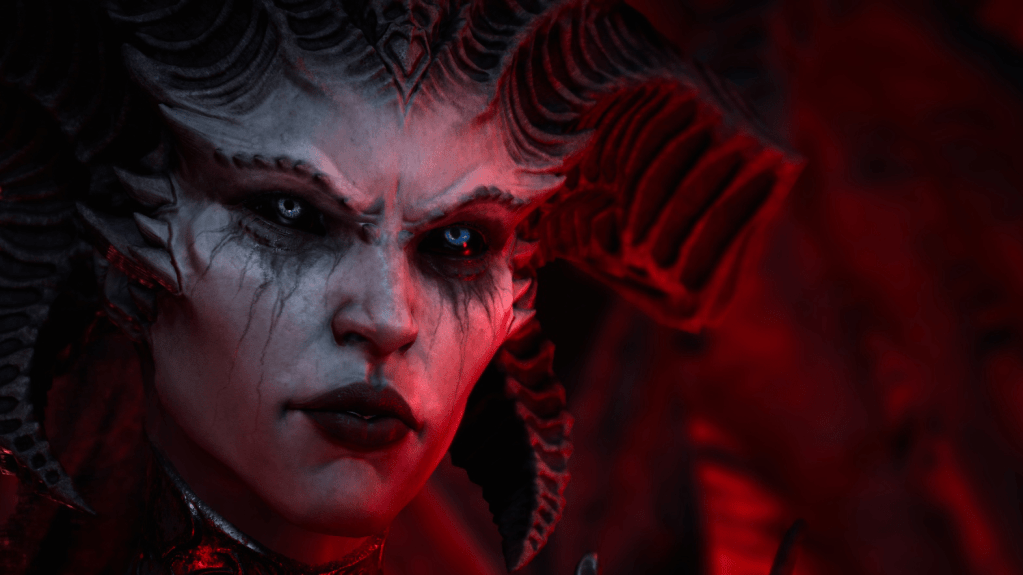
These cutscenes also showcase Diablo 4‘s graphics and art direction. It isn’t the most detailed looking game. However, ARPGs such as this hardly switch from its isometric view like Diablo 4 does, and it looks pretty decent while doing so. Additionally, this entry seems to have taken player feedback seriously, going for a more “realistic” look after some pushback from Diablo 3‘s cartoonish art. Not only does it go for a more realistic approach for its art, but Diablo 4 has some pretty gnarly instances throughout. Again, I won’t spoil anything, but there was one cutscene in Act 2 that cemented this notion, and it was pretty rad.
Overall, I think the story is pretty good, but I have some minor gripes. Most notably, I don’t know if I really like the ending. It’s well told, and it all seems logical, but there is something about it that just doesn’t sit right with me. Not to get too in the weeds, but by the end, it feels like they’ve just swept the problem under the rug, and the protagonist’s actions will probably haunt Sanctuary in the near future.
While an engaging story is certainly a plus, the series’ would not be where it is today without its incredibly fun gameplay. While it differs in some ways from its predecessors, Diablo 4 maintains the bloody, loot-driven action you expect from the beloved series.
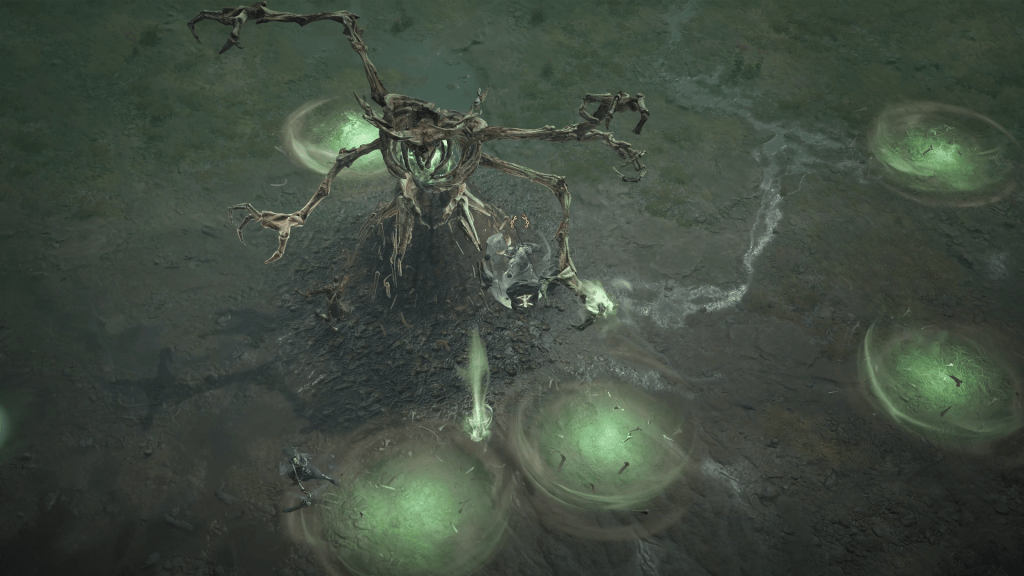
The core gameplay is exactly what you would expect from Diablo 4. You have a primary attack, as well as five other abilities to help you slay the demon’s terrorizing Sanctuary. How it differs is the pace of battle. It feels like an amalgamation of Diablo 2 and Diablo 3. The former is slower, and requires a bit more strategy due to its difficulty (yes, I’m bad at video games). The latter is very fast-paced, and is hardly a challenge unless you want to make it one by upping the difficulty.

At World Tier 1, which is the easiest difficulty in the game, Diablo 4 is an adequately challenging experience, but without being too frustrating. It edges more towards Diablo 3 in movement — this may have been amplified since I was playing the highly agile Rogue class — but you can’t solely rely on your dodge like in Diablo 3 since your dodge is on a cooldown. If I did any given quest when I was at its recommended level, I was able to complete it without too much hassle. Sure, there may have been points where I’d find myself in a sticky situation, but I was almost always able to find a way out. Even if I couldn’t, I always had enough potions to endure whatever Lilith’s followers had in store.
The only time Diablo 4 really presented a challenge at World Tier 1 was during the last act. Since the review build was only available for a limited time, I began mainlining the main campaign after Act 3. By the time I got to Act 6, I was level 38. However, the recommended level for these final quests were 45. I began doing some side quests just to see how long it would take to hit that level, but it felt like I wasn’t getting much experience. So, I decided to try to finish the game “under leveled.”
At first, I wasn’t sure if I could do it. Jumping into that beginning quest of the final stretch, I died three times in a row. Playing how I was playing for the majority of my time with Diablo 4 was not going to cut it. Instead, I had to take my time and try to only aggro a mob at a time so I didn’t get overwhelmed. It was legitimately challenging for me, but it was still fun which is very important. The game’s fun factor could have easily dipped drastically, but it didn’t, and that’s awesome.
Another small facet I appreciated was Diablo 4‘s approachable talent tree. As a Rogue, the tree has 7 nodes, with the first representing your primary attack, as well as passives that would buff those attacks. The rest of the nodes unlock as you dump points into any of the nodes. It is similar to the plethora of skill trees found in video games, but its simplicity and intuitiveness is what makes it approachable.
One of the biggest changes Blizzard made with Diablo 4 is make it a single open world. No longer are regions separated by acts. You can roam all of Sanctuary right from the start. It is a direction that just makes sense. While its open world design is pretty basic, the world itself is filled with so much things to do. Between the main quests, loads of side quests, dungeons to explore, and strongholds to thwart, there is plenty to do to keep you busy for hours.
I do wish the mount was available earlier during the campaign. By the time you start Act 3, you’re traversing a pretty large portion of the map, and you’re beginning the longest act of the game. Riding on horseback would have been nice to have specifically during that portion of Diablo 4 just to get through the slog that is Act 3. Luckily, you can teleport freely across Sanctuary as long as you find a waypoint.
After you’ve finished the main campaign for Diablo 4, you’ll enter the endgame which introduces more ways for you to improve your character and gain more powerful loot. While my time with endgame content was fairly limited, there seems to be a good amount of activities to dive into if you wanted to make your character even stronger.
Personally, I’m not sure I can see myself getting too deep into endgame content. Without a story to keep me going, it just becomes a very repetitive game about hacking walking bags of blood and meat. But I could see myself checking out some Capstone dungeons with friends or doing some Whispers of the Dead objectives to get some new loot throughout the year.
Diablo 4 is a solid entry in the popular Blizzard ARPG series. It recaptures some of that magic from its predecessors while integrating modern game design resulting in an engaging experience that is fun to play that is packed with tons of content. Despite some of its story’s blunders, it is a captivating tale that fans of the franchise should find entertaining. Eleven years is a long time to wait, but at least it was mostly worth it.
Score: 4 out of 5

 Bantam Banter